Jared Harris in The Wall Street Journal

Last week The Wall Street Journal published Marc Myers' House Call interview with Jared Harris, and the portrait that opens the piece is one of mine.

The sitting took place at my London studio. Harris was filming at the time, and he set the production aside for a day so that he could sit. That is not a small thing. A filming day is an expensive, jealously guarded commodity, and an actor who gives one up for a portrait is telling you something about the seriousness with which he regards the record of his own face.
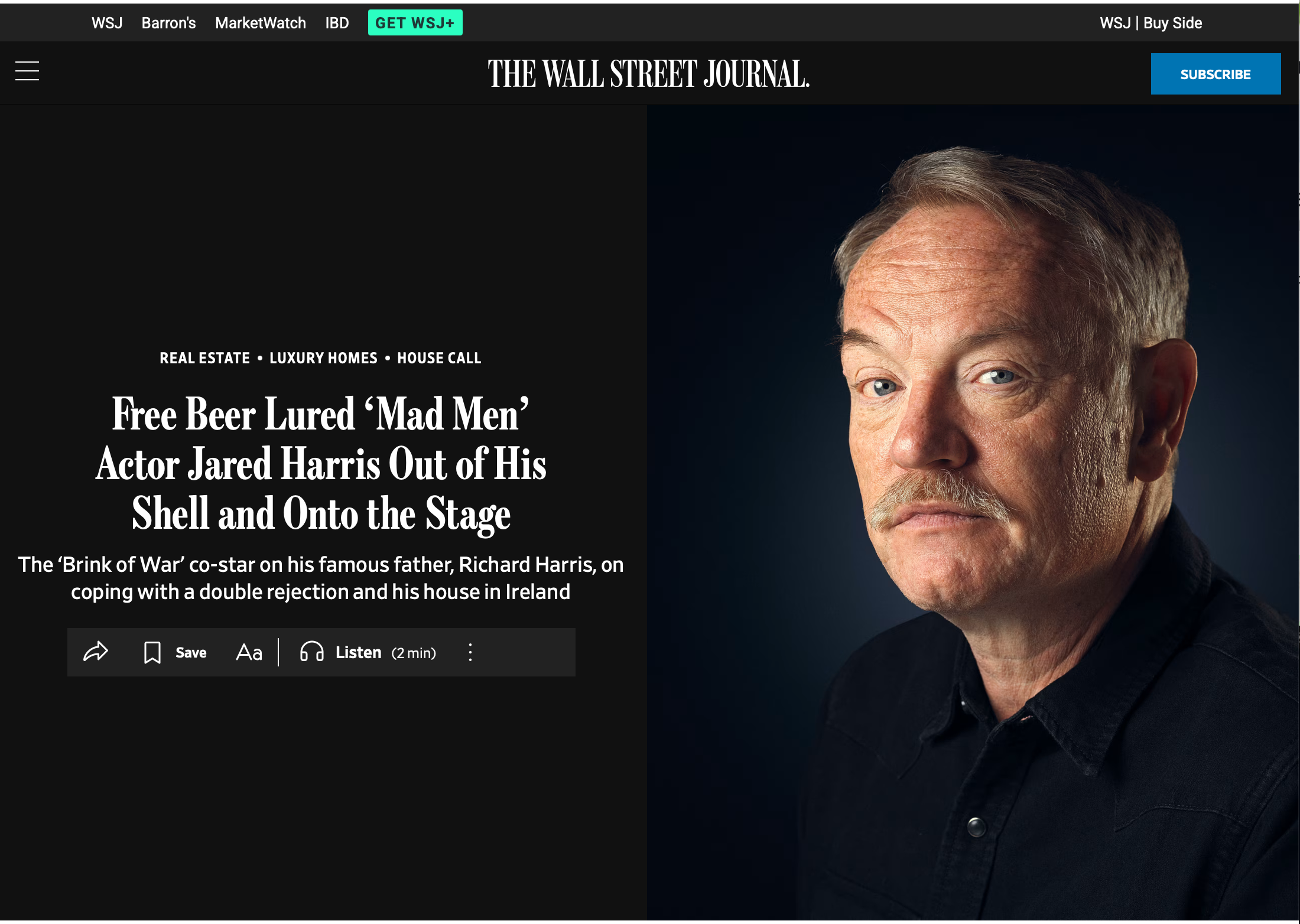
Jared Harris in The Wall Street Journal (Rory Lewis Photographer 2026)

My approach did not change for him. One light, a dark ground, and nothing between sitter and lens but attention. It is the discipline Holbein drew by and Rembrandt painted by, and it asks a great deal of a face, because there is nowhere for the face to hide. Harris's can carry it. This is a man who has played Lane Pryce's slow unravelling, Valery Legasov's conscience and King George VI. The Journal ran the portrait large β€” dark shirt, dark ground, the light doing its work from one side β€” and the face holds the page entirely on its own.

Myers' interview looks back at the beginning: a childhood in Kensington and Notting Hill, boarding school after his parents' divorce, and the improbable route, by way of free beer at a university theatre, that carried him to the stage. And, of course, his father. Richard Harris belonged to a generation of actors whose portraits became part of the furniture of the age, and photographing the son, half a century on, felt like adding a line to a story already long in the telling. There is a tradition of the actor's portrait in Britain that runs back through the mid-century studio photographers to Lawrence's paintings of Kemble, and I take that lineage seriously every time an actor sits for me, as Sir Ian McKellen, Sir Patrick Stewart and Dame Judi Dench have done.

The portrait reached the Journal through News Licensing and Redux Pictures, four years after it was made. That is the long second life of a properly made portrait: the sitting ends in an afternoon, and the photograph goes on working for years. It is why I photograph the way I do β€” not for the week of the publicity cycle, but for the record.

I photograph actors and public figures at my studios in London, Los Angeles and New York.