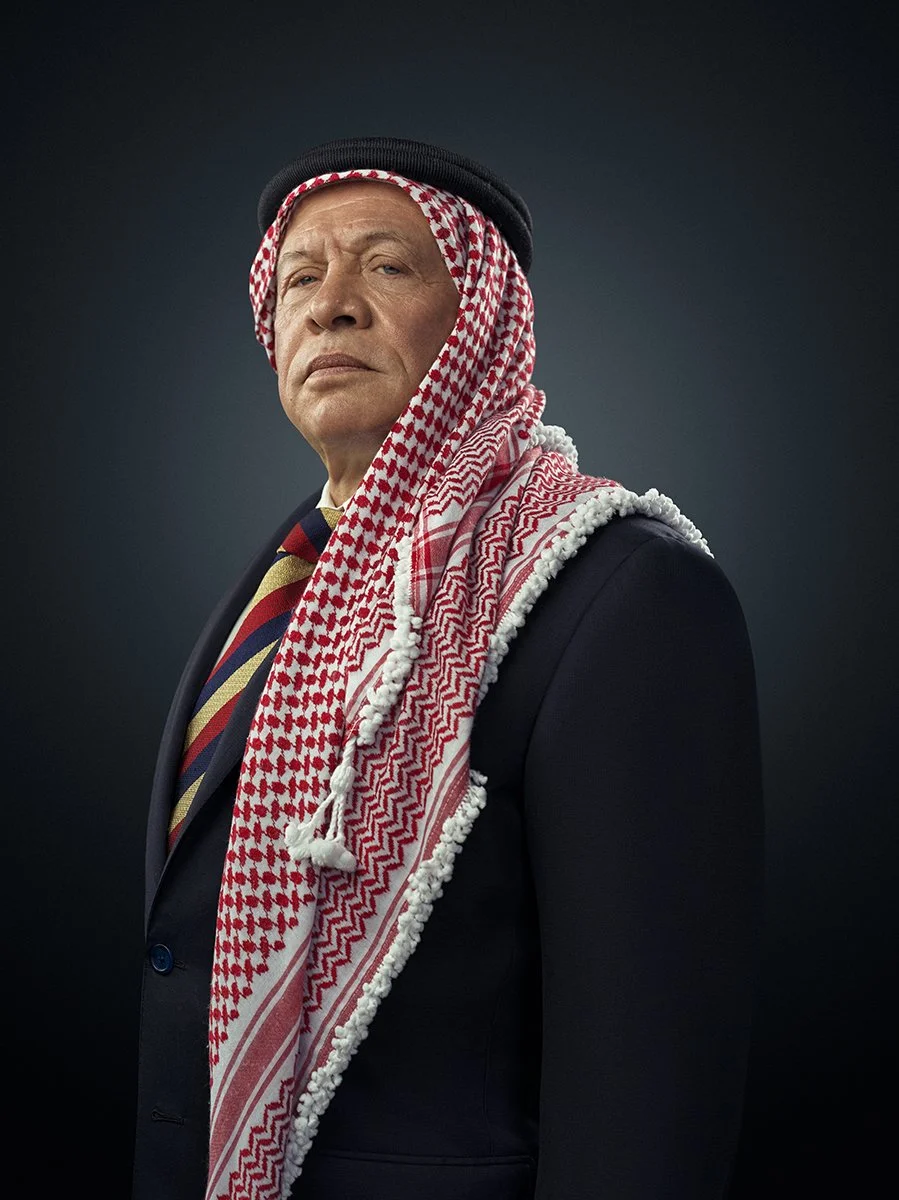
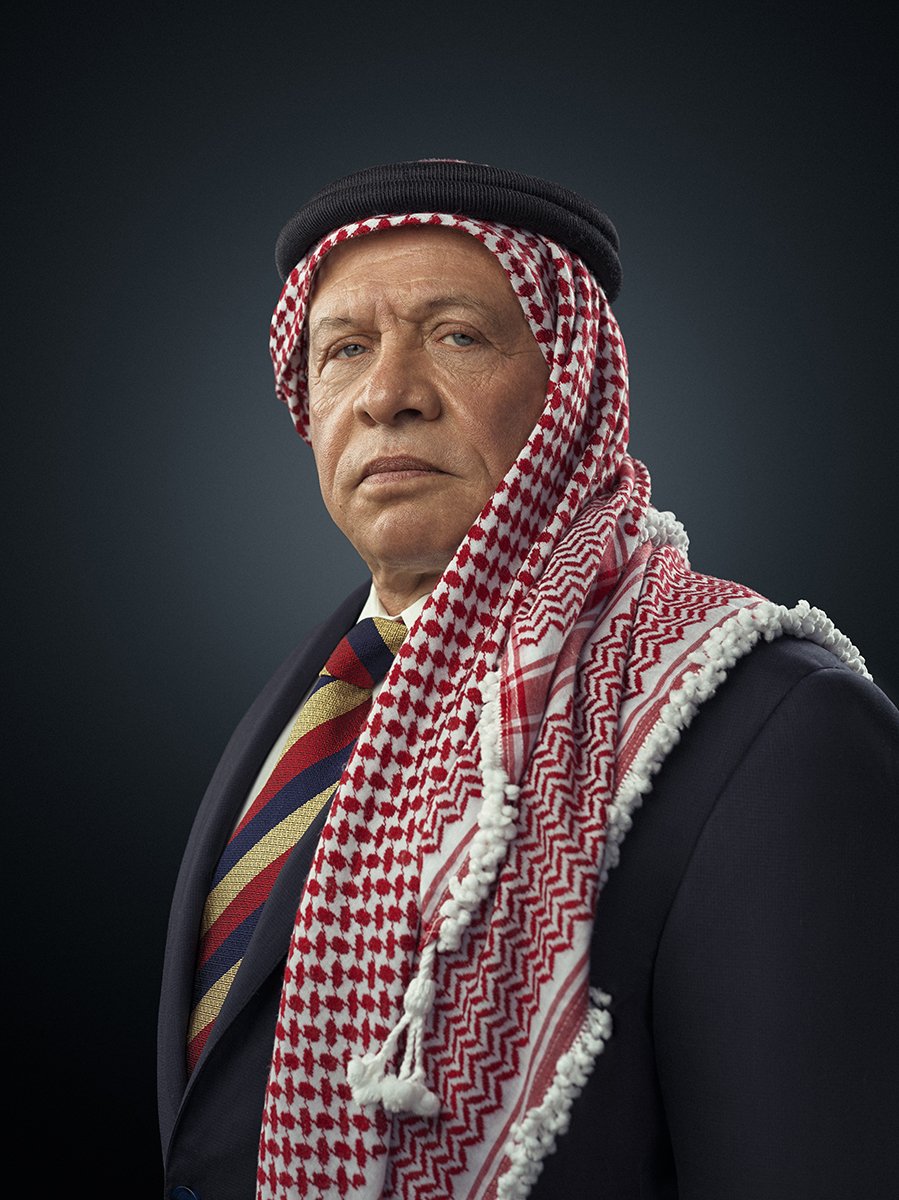
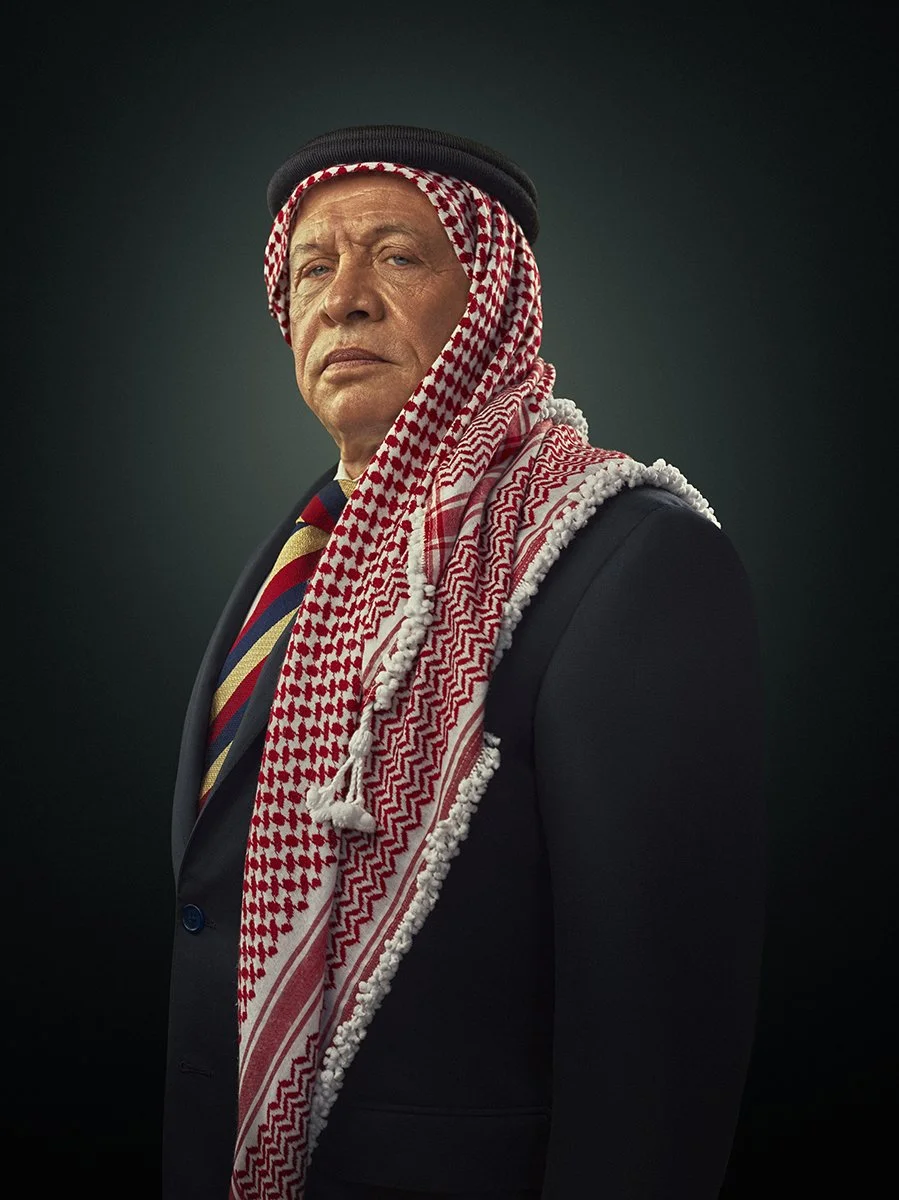
On Saturday the 25th of July I photographed His Majesty King Abdullah II of Jordan — a fifteen-minute sitting undertaken on behalf of the regiment, for which I flew from Los Angeles. Fifteen minutes is nothing and everything. It is the same window Holbein would have been granted at the Tudor court, the same economy of time in which Van Dyck learned to read a face and fix a likeness before the sitter had finished settling into the chair. You do not get a second exposure with a king. You prepare for weeks so that you are ready for a quarter of an hour.
I came bearing gifts in the old sense — not flattery, but tribute in the language I speak best. I presented His Majesty with a Caravaggio-inspired print set of Sir Patrick Stewart, and a personalised album of the British Army portraits I have made over these last years: the Household Cavalry, the Royal Lancers, the Rifles, the Welsh Guards, the Italian cavalry regiments of Rome and Codroipo. A soldier, whatever his rank or nation, reads the lineage in another soldier's face. I wanted the King to see the company he was joining on my walls.
For me the significance runs deeper than a single frame. My royal sitters until now have been Prince Michael of Kent and the Duke of Kent — men of the blood, but not the crown itself. With this sitting, a reigning monarch enters the archive for the first time. The line that runs from the Old Masters through the state portrait tradition — Rembrandt's burghers, Van Dyck's Charles I on horseback, the grave dignity of a Titian doge — has always been, at its summit, about the depiction of sovereigns. To photograph a king in that idiom, with tenebrism and chiaroscuro rather than paint, is to place a living monarch inside a five-hundred-year conversation about power, duty, and the human face beneath the office.
It has made me reflect on where this work now stands. I have spent twenty-three years building a practice rooted entirely in the tradition of the Old Masters — Caravaggio, Holbein, Van Dyck, Rembrandt — and carrying that tradition, deliberately and stubbornly, into three cities at once: London, Los Angeles, and New York. As far as I know, I am now the only classical portrait photographer still practising across all three. Others have modernised, moved on, chased the clean bright commercial look. I have gone the other way — deeper into shadow, deeper into history, deeper into the belief that a portrait should carry the weight of centuries.
This is the mission behind Heroes in Focus as well: to build a living archive of those who serve, made in the grammar of the masters, so that the faces of soldiers and sovereigns alike endure as a record of courage and sacrifice long after all of us have hung up our boots. A king photographed today becomes, a century from now, a document — the way that 1915 presentation photograph of George V is a document to us.
My hope is that this is a beginning rather than a conclusion. I would be honoured to photograph the Jordan Armed Forces, and to be granted a longer sitting with His Majesty in time. Fifteen minutes gave me a portrait. A morning would give me the man.
For now, I am simply grateful. To have carried a camera into the presence of a reigning king, and to have answered with the only thing I know how to offer — light, shadow, and the long memory of the masters who taught me how to use them.