There is a particular quiet that settles over a portrait sitting when the subject is, by trade, a maker of sound. The performer who fills a room — who has stood in front of seventeen thousand people at the Coca-Cola Arena and held them — arrives in my studio and discovers that the only instrument I am asking him to play is his own stillness. Nick Pritchard understood this faster than most.
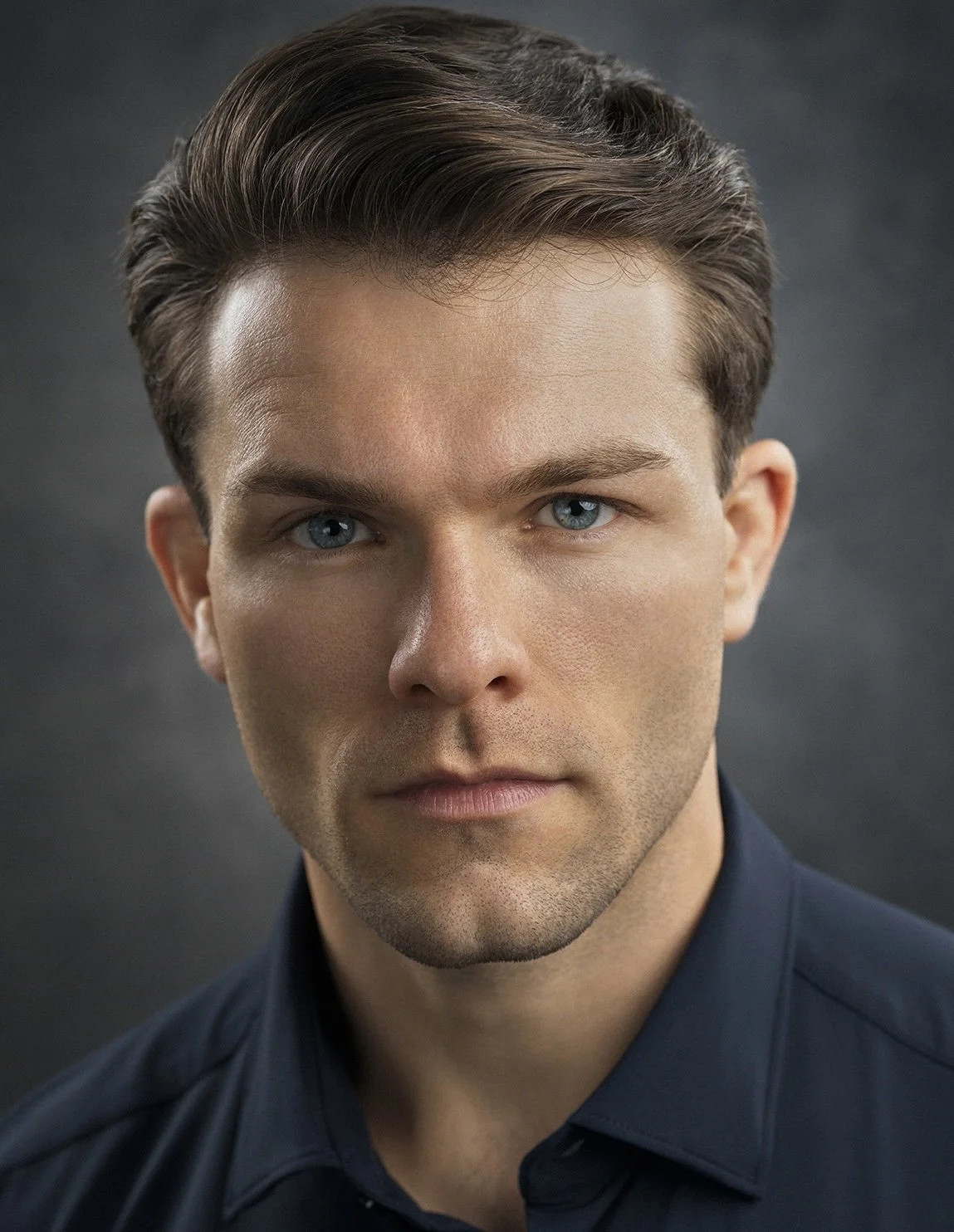
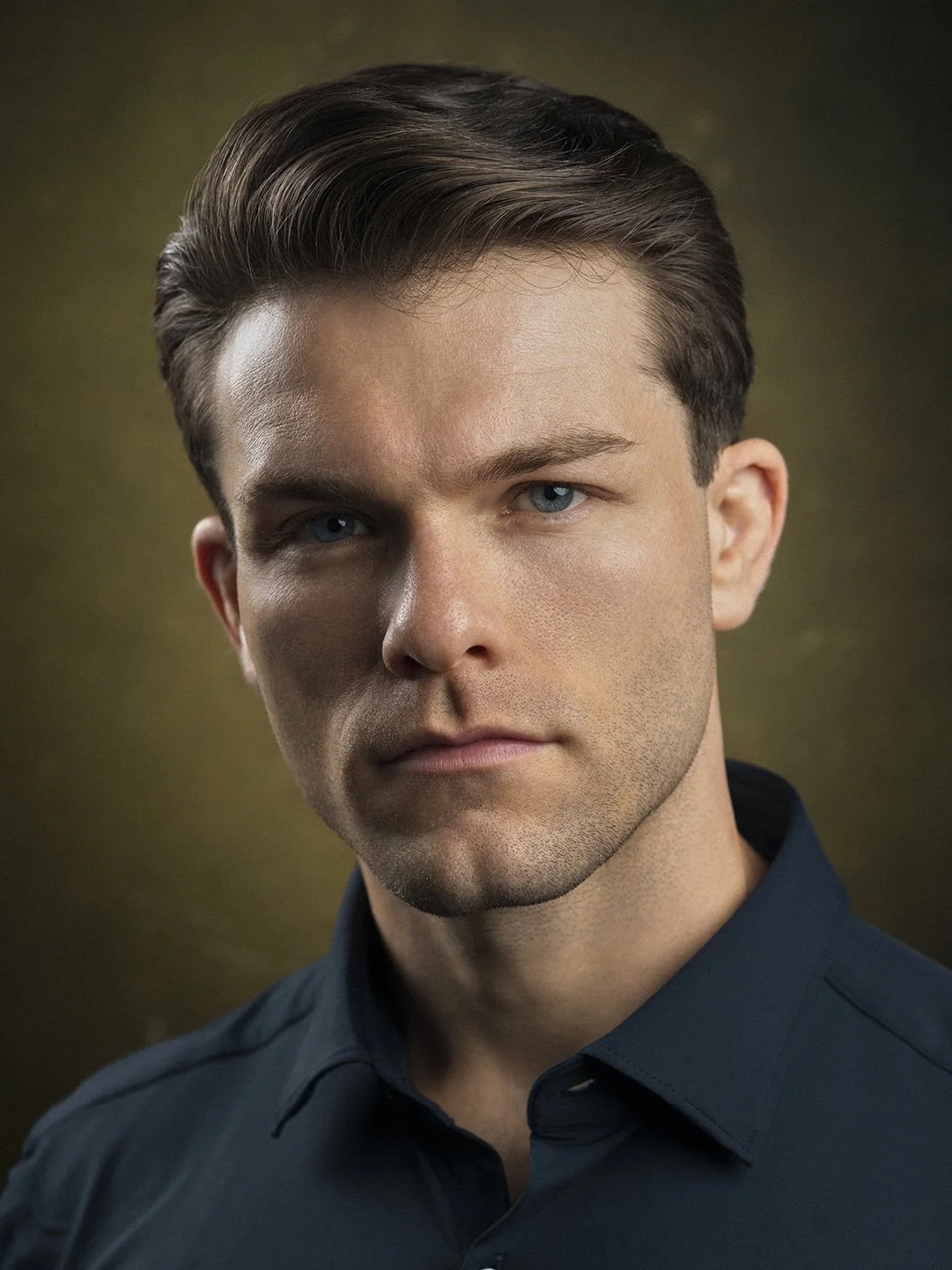
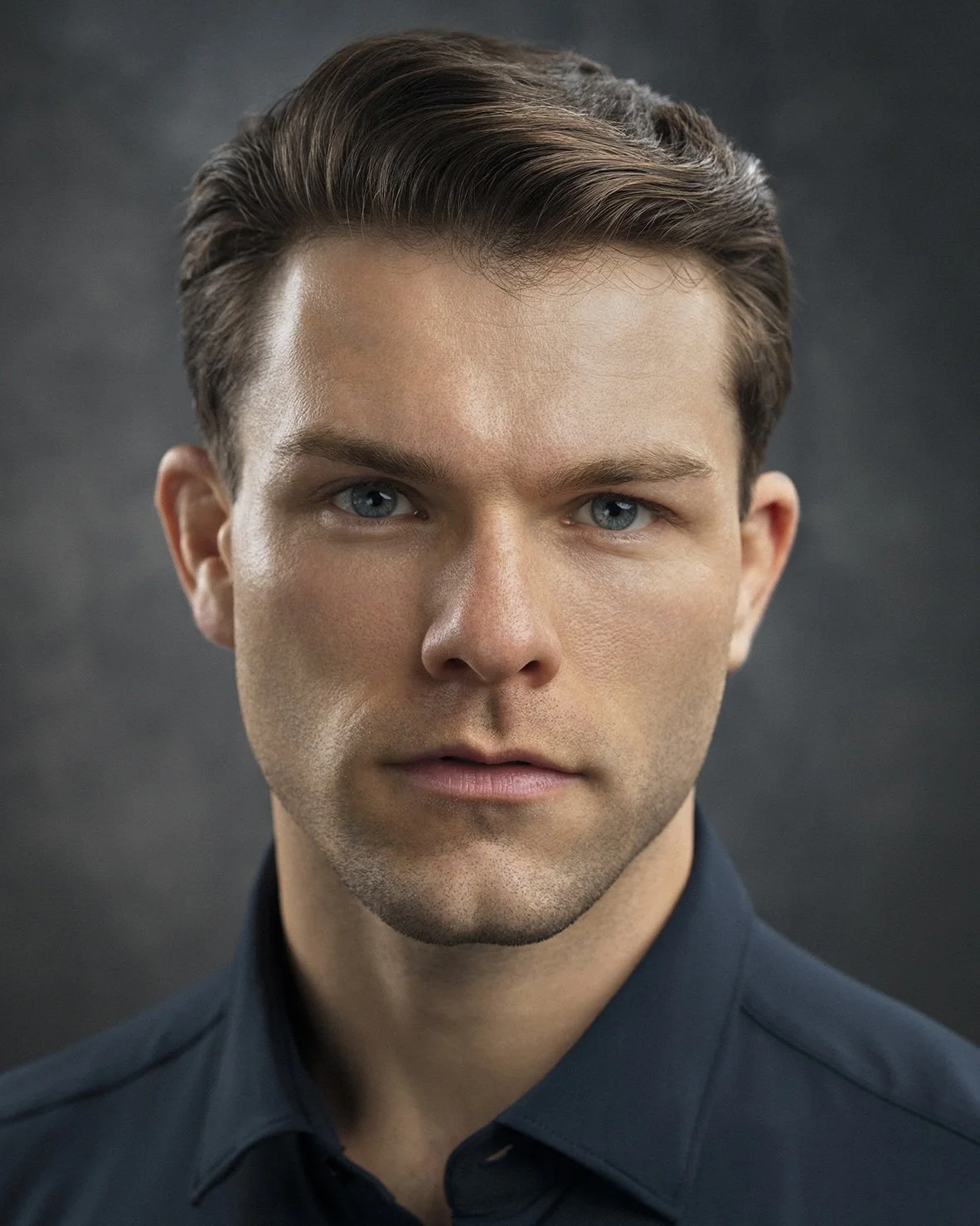
He came to the Downtown Los Angeles studio in a navy shirt, the colour I quietly hope for: it drinks the light rather than throwing it back, and it lets a face do all the speaking. And Nick has the kind of face that rewards the patience. A strong, clean jaw, a brow that holds tension without frowning, and those pale blue-grey eyes that change temperature depending on where I set the key light. In the grey frames they read cool, almost glacial — the eyes of a man weighing something. Against the olive ground, with the light pulled hard to one side in the old tenebrist manner, they warm and deepen, and the whole face tips toward Caravaggio. Same man, same hour, two entirely different inner weathers. That is the thing I am always hunting for.
Most people who find their way to my chair carry one self. Nick carries at least two, and they were both in the room. There is the screen actor — recently Dom Maitland, the jazz singer, in Rivals, the Disney+ series that took six BAFTA nominations and an International Emmy, where he stood in the frame opposite David Tennant and Danny Dyer and Emily Atack and not only acted the part but actually sang it, co-arranging and performing the music as well. And then there is the vocalist proper — the man who has played James Bond on a Dubai stage, opened for Ricky Martin, busked the streets of London long before any of the rest of it. The crooner's polish and the actor's restlessness do not always sit easily in one body. In the best of these portraits, you can feel them both, held in suspension.
I worked the olive frame the way I'd approach a Selah sitting — light raking across one cheek, the far side surrendered to shadow, the background no longer a backdrop but a kind of dusk he is emerging from. It is a Rembrandt instinct, really: let the darkness do half the work and trust the viewer's eye to lean in. The grey frames are the corrective to that romance. Cleaner, more level, the lighting wrapped and even — these are the images that an agent or a casting director wants on the desk, the ones that say here is the man, no theatre, look at him. I like to give a sitter both registers in a single session, because both are true and neither alone is the whole story.
What struck me, beyond the bone structure that the camera frankly adores, was his ease with direction — the actor's gift. A small instruction ("drop the chin a degree, let the eyes stay up") and he'd find it instantly, then hold it without the strain that creeps into most faces after the third second. I suspect this is what the stage gives you that nothing else can: the knowledge of exactly where your own face is in space, and the discipline to leave it there.
We share, as it happens, a geography. Nick lives between Los Angeles, London and Dubai; I move between Los Angeles, New York and London. There is a particular kind of person being minted now who belongs to no single city and is at home in the departure lounge — and I find they often make the most interesting sitters, because the rootlessness teaches a certain self-possession. You learn to carry your stillness with you.
He'll be back in front of more demanding lenses soon enough — a second series of Rivals, an expanded role, more songs recorded; film work building behind it. For an afternoon, though, he sat in the dark in a navy shirt and let me look at him properly, without a single note sung. The singer's silence, it turns out, photographs beautifully.